



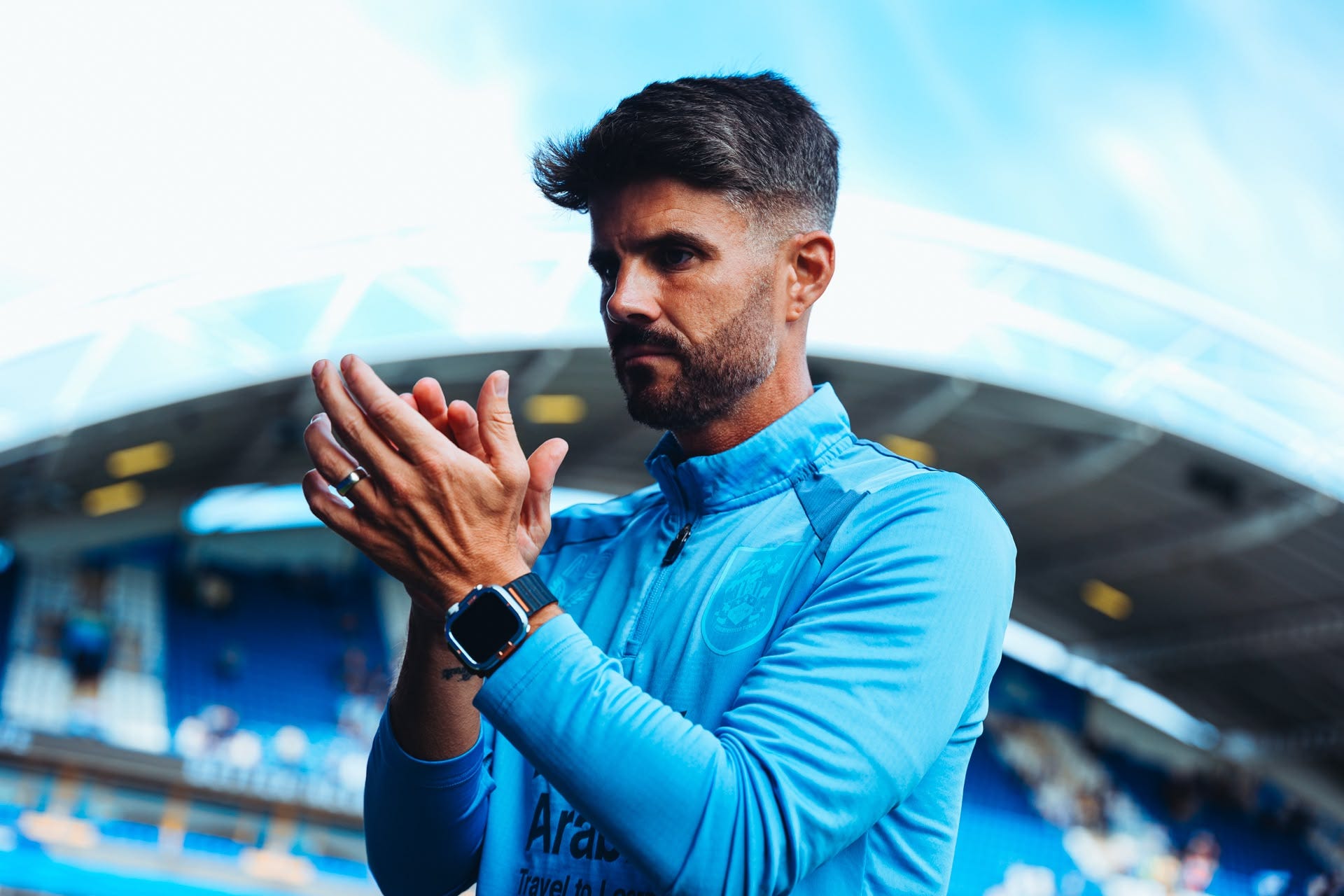
Here are some of the edited highlights from the press conference — you can find the full audio above or in your podcast feed, including Ibane Bowat section of the presser.
Martin Drury
Bali Mumba is suspended. Did everyone else come through okay, and are you able to welcome anyone back this coming weekend?
We had a couple of knocks on Saturday, so we will have to see what they look like towards the back end of the week.
We will have to make a late call on two players, which is frustrating for the first game, but the games begin to block out some of the lads.
We will have a look at those at the back end of the week in terms of players recovering and coming back into it.
Archie Collins is still building up, taking a little bit more time, but I would expect him to be close towards the weekend.
Sean Roughan unfortunately has a thigh strain, which will keep him out for a period of time, so Sean won’t come back.
There is no more change besides that.
Will you share the two who picked up knocks?
No.
Is it three games for Bali Mumba?
Yes.
He has a pretty unique skill set in your squad. Does that make it difficult to replace him? Do you have to think about things differently without Bali available?
Again, it is game to game. It depends who you are playing against.
Saturday, I felt it was the right game for Bali to play off the left because we thought we could get the ball wide into one-v-one scenarios, and with Wimbledon going down to 11 v 10, we might have an opportunity to have more of the ball, which suits Bali.
There will be other games where we will have that. There will be other games where there will be more set plays, more long throws, more direct play and more physicality.
We have got a squad where we have to utilise all the skill sets we have, and it is up to us as a staff and the players to prove that we get it right each week.
Of course, Bali is a really good player. On Saturday, I thought he started the game really, really well. It was disappointing to lose him in that game, and to lose him now for the next three is disappointing. He is a good player.
There is always an opportunity when you lose a player. Watching the under-21s last night (a 4-1 win over Gillingham), Jay Sway got a goal and an assist. Does he come into your thinking at all?
He was already in my thinking.
Some players missed out on Saturday because of the numbers we have, and it was based on what the game looked like and what the next game looked like.
It will be different, and as you say, with people being suspended and injured, I said to the players straight after the game on Saturday that there is absolutely zero chance of being successful this season if we are going to do it with 11, 12, 13 players. Impossible.
We need the whole group to be ready. We need the whole group to stay focused, whether you are starting or not starting. That means every day in training, everyone being fully engaged in what we are doing.
Players like Jay and other young players are hugely a part of that.
The challenge for us is to pick the right team, but the challenge for the players is to force our hand and say: “Look, I need to be on the pitch.”
Jay falls in the second category, the same as everybody else. Every day is an opportunity to make sure you are playing on Saturday.
With the likes of Ethan Brierley and Joe Low in that side last night, is it different as a head coach compared with being an assistant when you have a big squad and inevitably players are going to miss out and be disappointed? Does the relationship change for you?
It is different. It is definitely different.
I have had many conversations with the players since coming back around the difference in it. They can feel it, I can feel it, but that is the nature of the job.
I still care for every player and want the best for every player.
After the game on Saturday, I was considering which players might benefit from minutes in the [U21s] game, because some of the players you speak about had not had minutes for three weeks. In the latter stages of pre-season, you start building for that first game.
The beautiful thing for me is that Joe Low is coming in saying: “I want to play in that game.” He is not saying: “Why am I playing with the 21s?” He wants to play in that game and get the minutes.
When you have got that attitude, you are already a step ahead.
When you have got players who say, “Let me play in the game, let me get some minutes so I’m ready for you,” that is the attitude of the four who played last night.
I thought they all played really well. They treated the game exactly as they should. They got what they needed from it, and that puts them a step closer to playing.
Playing in those games is not a step back. Playing in those types of games is a step closer — getting the minutes you need so you can be physically and mentally ready for when you are called upon.
As I said, testament to all four of them (Low, Brierley, Sway and George Sebine). I thought they played really well last night.
Reflecting on Saturday, coming into a new season with the expectations and everything everyone talks about, just how vital was it to get underway with a win and a performance like that?
It is always nice to start the season with a win.
As I said before the game, the first game of the season is always a little bit different. The emotion of it, whether you are home or away, a lot of people read into things straight after that game. If you win, suddenly you are going to have a great season. If you lose, it is a disaster.
It is always nice just to start on a positive note. But as you rightly say, the performance was in line with the result, I felt, so that was probably the most pleasing aspect.
When you had your debriefs with the players this week, what are the things you picked out that you want them to keep doing?
Everything I always talk about is: how were we better than the last game?
When we looked at the Preston game, what we took away from it was that we didn’t feel we controlled the ball well enough. In particular moments of chaos, we weren’t able to take control of the ball.
That was one of the biggest takeaways from the game on Saturday: in those moments, we were either really threatening from an attacking point of view, counter-attacking, or were able to connect passes and try to take some control of the game. That is where I feel the players we have are at their best.
As I always say: what did we learn from the last game, and could we be better at it this week? We were, in some moments.
Again, dealing with direct play and defending the box the way we did against Preston and the way we did against Wimbledon was another step forward for the group. Credit to them for how they dealt with the threats of Wimbledon that were similar to Preston.
When you talk about learning and being better in the next game, if we are being picky, where are the areas where you feel your side could be better?
There were some key moments in the first half that I won’t talk about too much, but the game could have been gone earlier.
We had moments to score more goals in the first half, whether that was through choice or through quality — just those little bits.
Even when we were down to 10 men, and I am being picky, some things without the ball, in terms of recognising when the opponent is going to put the ball in behind us and being better to deal with that threat.
When you defend as well as we have over the two games, in terms of closing the middle of the pitch, teams are going to go to the side and cross it, or they have to put the ball in behind.
We dealt with the way the ball came in from the sides really, really well, but in terms of balls in behind us, there were a couple of moments in particular where there are small tweaks I felt the group could improve from.
We discussed that in the post-game, and I thought the players, in terms of their answers, were really aligned in that.
That is something we have looked at this week in terms of what we are going to need going into the game on Saturday.

Ibane Bowat
Am I right in thinking you had a spell going down the rugby union path?
I did.
Can you tell us a little bit about that?
That was after my time at Chelsea.
I left when I was about under-12 or so, and I fell out of love with football a bit. At that time there was a lot of change in my personal life and a lot going on. I just felt as though I needed a bit of a breather.
I was playing rugby for the school team. I was pretty good, so people were telling me to take it more seriously, which I did.
I ended up going on trial at Harlequins, got picked up there and also represented my county, Surrey, at the time.
I was enjoying it. It is a tough sport, physically demanding. One day I went into a bad tackle and got injured pretty badly, and I was like: if I’m going to go down this path, I need to get used to this. I thought I wasn’t quite cut out for it.
I was also missing football, so I decided to go back to that. Now I’m here.
What made you fall back in love with football?
It was a mix of things.
At that age, in academies, it can be very intense. There is a lot of pressure. As I said, there was a lot of change around me, and sometimes it can just get a bit too much.
A big part of it was my dad as well. He has always been a big part of my football and my early football career, always taking me to games and training.
He had to go away for a little bit of time, and I ended up going to training by myself. I was in Tooting, South West London, going to Cobham to the training ground by myself at the age of 10, which was about an hour on the train.
Doing that a few times a week got a bit demoralising after a while.
When my dad came back to London and we were able to start watching football games together, going to watch Arsenal or Chelsea at the stadium — he is an Arsenal fan and I’m a Chelsea fan, so he juggled between both for me — having him back and supporting me was a big push for me to think: all right, let me get back into this.
I’m happy it turned out that way.
Your dad is an Arsenal fan and you’re a Chelsea fan. Who were your idols growing up?
At the time, for me, it was the Drogbas, John Terry, Frank Lampard — those iconic Chelsea players I grew up watching.
My dad was more into the Bergkamps and Vieiras, so there has always been a bit of a divide in the household, but we stayed friendly.
Any other sports you can turn your hand to?
A little bit of basketball, tennis.
I’m lucky that my parents, growing up, threw me into lots of different sports, which I think has helped me develop a plethora of skills I can now apply to football. So I’m grateful for that.
Looking at your time at Portsmouth, you joined a Championship club but got injured and were out for nearly a year until you made your debut. Talk us through that period, because mentally that must have been tough.
It’s not easy.
I signed for Portsmouth and then 10 days later, in training, I had a shock injury, really. I ended up tearing my patella tendon, which had me out on the sidelines for about a year.
It’s tough because when you arrive in a new environment, you want to get in, make a name for yourself, show the fans and your teammates what you can do, and establish yourself within the group.
I wasn’t able to do that, so quickly I was just put onto the sidelines and sort of forgotten about. It is hard to impose yourself.
During the injury there are ups and downs. It is never really linear and smooth.
It wasn’t an easy journey, but Portsmouth were great in terms of getting me back to full fitness, and my family and everyone around me supported me, so they made the journey as smooth as it could be.
When I was back, I was just raring to go.
I’m sure you relish this opportunity anyway, but with what happened there, does it feel even more important to make something of this opportunity?
For sure.
It was a year full of ups and downs, blood, sweat and tears, literally.
To be back now and fully fit, as I have been for the past year, feels good, and it really motivates me because now I know I need to get going and get back to the levels I know I can play at and beyond.
It is about having more trust in my body now and not taking my full fitness for granted. Every day now, doing extras, making sure I’m on top of everything — I think that injury has helped me.
You spent time out on loan in the Netherlands and Austria. Austria seemed to be a place where the media and fans really praised your performances. Were those experiences important to your development?
One hundred per cent.
At the time, leaving Fulham, we thought going abroad was a good option for me because you learn different styles of play.
To be able to show teams in Europe that I could leave the nest and adapt to different environments was important.
On a personal note, learning different cultures, meeting different people and learning different languages is something I enjoy doing.
That was an important step for me in becoming a more well-rounded player and person.
Have you tested yourself on the Dutch lads?
Yeah. When I was out there, I tried learning Dutch. It was tough. It is a difficult language, but I have got a few words here and there!


