

Why the goals have dried up for Huddersfield Town and how they can fix it
Formerly the top scorers in League One, the Terriers have failed to score in three of their past four games and failed to have a shot on target in two of them. What gives?

It won’t have escaped your attention that Huddersfield Town have struggled for goals and creativity recently. So, when did this decline start, and is it the fault of Liam Manning?
We’ll answer the second part first: basically, no.
Although Town were previously the highest-scoring side in the division, they had a notable spell earlier this season when they struggled to create regular goalscoring chances.
According to FBRef, in their league games this campaign, Town have averaged 12.4 shots per game. (Opta says 12.6, but that’s a difference of about four shots over the course of the season and it proved easier to get a game-by-game breakdown from FBRef, so we’re going with that).
Town started the season with reasonably consistent numbers around that average, but became inconsistent from the end of September (away to Exeter) to the end of November (at home to Wimbledon).
In the space of those eight games, Town recorded 20 or more shots on goal four times, but also registered fewer than 10 shots in three games. (It was a similar story on expected goals, where Town exceeded 1.5 four times, and went under 0.75 three times).
At one point, the goals looked like they were going to dry up entirely. In the six league games between their trips to Bradford and Wycombe, Town scored just four times.
It took a short-lived move to a 4-4-2, a stellar run of goalscoring form from Leo Castledine, and the revelation of Bojan Radulovic as part of a front two for Town to revive their fortunes.
At the same time, the Terriers were conceding two to three goals per game far too often. In a bid for more consistency, Lee Grant switched Town’s shape again, playing a back three from December onwards, starting with the trip away to Northampton.
Since then, Town’s shots per game has been lower on average, but with less variance from game to game. That average has remained almost the same since Liam Manning took over, regardless of which shape he has played.
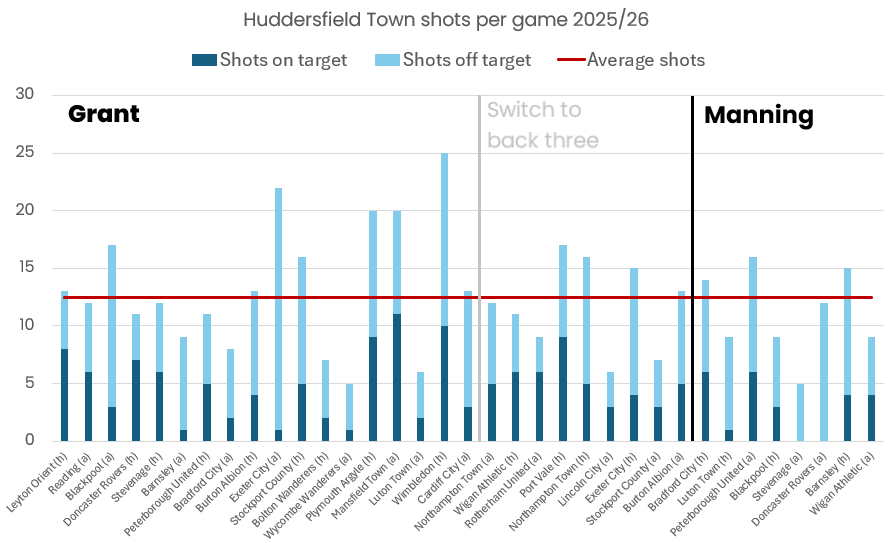
Under Manning, Town struggled to create chances against Luton, Blackpool, Stevenage, Doncaster and Wigan, all of which fell short of the shots per game average for the season.
Luton is easily explained by Town being reduced to ten men around half an hour into the game. Three of the other games — Stevenage, Doncaster and Wigan — were all against sides who Town had also struggled to create chances against in the reverse fixture.
Although we’re not overly concerned with their defensive record here, it’s worth adding that there is some merit in Town’s change of approach.
Since Grant’s change of tack in December, Town’s defensive record has been much improved under both managers — particularly from open play. Overall, Town have conceded 17 goals in their past 16 games since Grant’s formation switch, having shipped 29 in 19 before then.
Still, it’s clear that they are no longer the attacking force they were earlier in the campaign. Their past ten league games have yielded just ten goals, with Town drawing a blank on four occasions. They had only failed to score twice in their previous 25 games.
What is the cause of all this, then, and is there still hope that Town can turn things around?
After trawling through the numbers and watching back the clips, here are the reasons we think Town have struggled to create chances over the past couple of months.
Keep reading with a 7-day free trial
Subscribe to We Are Terriers to keep reading this post and get 7 days of free access to the full post archives.